

Could an independent review identify evidence or unanswered questions that have not been properly examined? A miscarriage of justice investigation can assess case papers, analyse evidence and explore potential lines of enquiry, but it cannot overturn a conviction. That distinction matters when the next step feels uncertain and the case file is difficult to organise.
It’s understandable to want a thorough review while also wondering whether it can lead to anything meaningful. Investigative findings may help clarify issues for consideration through formal legal routes, but decisions about appeals or referrals rest with the relevant legal bodies, not a private investigator. Investigation and legal remedies have separate roles.
This article explains what an independent case review may examine, how it relates to formal appeal routes and what to prepare before discussing a sensitive case. Pink Investigations Ltd provides tailored document review, evidence analysis and investigative support under the oversight of Susie, a former Police T/Detective Inspector. The aim is to assess the material carefully and identify unresolved issues, without promising a particular finding or outcome.
Key Takeaways
- A miscarriage of justice investigation can involve structured document review and evidence analysis to identify inconsistencies, gaps and questions for further enquiry.
- Independent investigators cannot overturn convictions or replace legal representation or the CCRC; their findings may help inform consideration of formal legal routes.
- Prepare a brief chronology, the current conviction and appeal status, your main concerns and a list of available case documents before discussing a review.
- Keep sensitive original documents secure and start by organising what is available, rather than sending originals prematurely.
- Pink Investigations provides tailored case review and appeals support, with investigative oversight from Susie, a former Police T/Detective Inspector.
What does a miscarriage of justice investigation involve?
Concerns about a conviction can be distressing and difficult to assess, particularly when the case involves extensive paperwork, conflicting accounts or unanswered questions. A miscarriage of justice investigation provides a structured way to examine those concerns. It may involve reviewing case materials, analysing evidence and identifying specific issues that could warrant further enquiry.
A case investigation examines evidence and unresolved questions; an appeal is a formal legal process in which a court considers whether a conviction or sentence should change. Investigative findings can clarify what the available material shows, but they are not a court decision, an appeal outcome or a statutory referral. An independent investigator cannot quash a conviction. The broader meaning and contributing factors associated with a miscarriage of justice can vary, so each case needs careful examination rather than assumptions based on a general example.
What may prompt someone to seek an independent investigation?
Concerns may relate to evidence that appears inconsistent, material that may not have been disclosed or examined, differences between witness accounts, or decisions made during the original investigation. These are matters to explore, not proof that a conviction is unsafe. Disagreement with a verdict, on its own, does not establish that an error occurred.
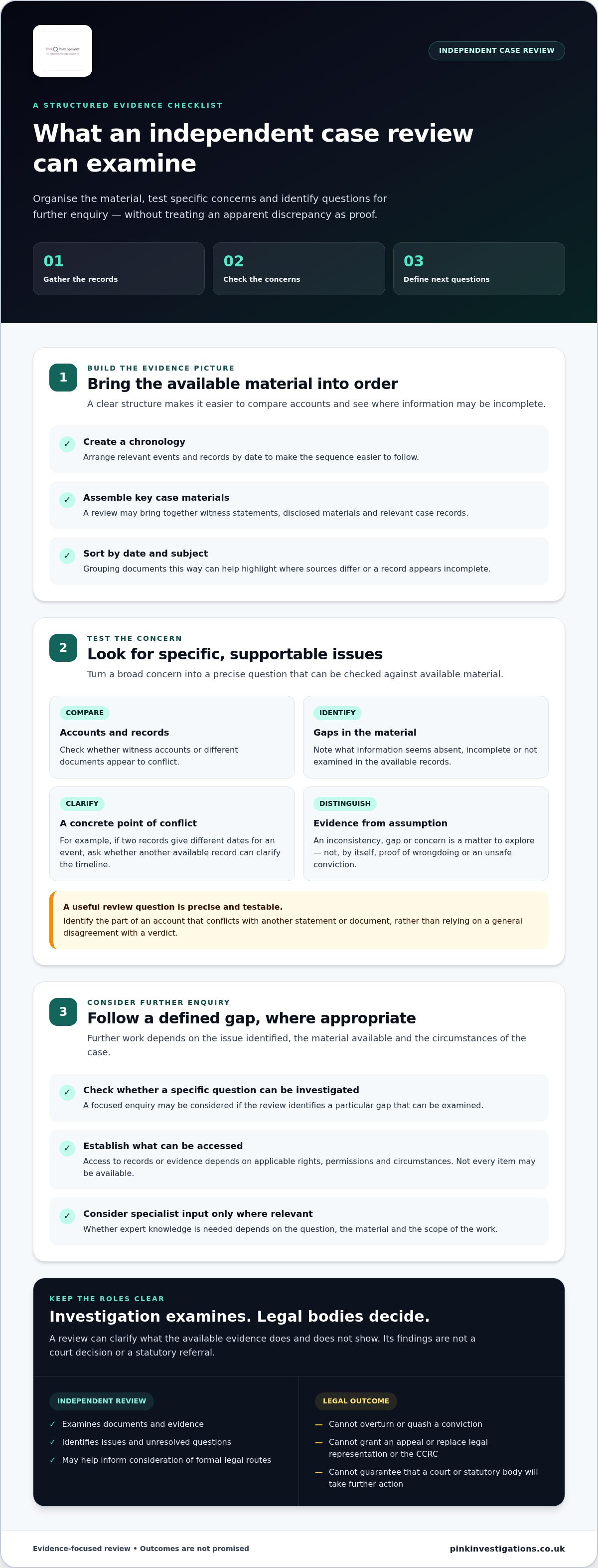
A useful starting point is to turn a broad concern into a precise, testable question. Rather than saying that a witness was not credible, for example, identify the part of the account that appears to conflict with another statement or document. This gives a review a defined focus and helps distinguish verifiable issues from speculation.
Who may seek case-review support?
A person who has been convicted may seek support to understand whether particular aspects of their case merit closer examination. A family member may also raise concerns or help organise information, especially when the person affected finds it difficult to manage the papers alone. Legal professionals can seek investigative input where a focused review may assist their understanding of the available material.
Each enquiry requires an individual assessment of the circumstances, the questions being raised and the documents available. The scope of any work depends on the case. An initial concern may lead to a focused document review, or show that the available information does not yet answer the central question. A measured assessment helps set realistic expectations without suggesting that further investigation will produce a particular finding.
For an overview of the wider options and formal routes that may follow a conviction, see this criminal case review UK guide. Independent case-review support is distinct from legal representation and from the role of a statutory body. Its purpose is to examine material and clarify issues, so that any next steps can be considered on a more informed basis.
What can an independent miscarriage of justice investigation examine?
An independent review can organise the available case material and examine it against clearly defined concerns. This may help identify inconsistencies between records, gaps in the information available or points that warrant further enquiry. The scope depends on the circumstances of the case and on what material can properly be accessed.
An investigation identifies and examines potential issues; it does not decide legal outcomes. Its findings cannot quash a conviction, grant an appeal or guarantee that a court or statutory body will take further action. They may help clarify what the evidence does and does not show. A miscarriage of justice investigation should therefore be treated as evidence-focused work, separate from the legal decisions that may follow.
How can documents and evidence be reviewed?
A review may bring together a chronology, witness statements, disclosed materials and relevant case records. Organising these items by date and subject makes it easier to compare accounts and identify where a record appears incomplete or two sources differ. Investigators can document those points for further scrutiny, rather than treating an apparent discrepancy as proof of wrongdoing.
Access to records or evidence depends on the applicable rights, permissions and circumstances. Not every item someone hopes to review will necessarily be available. A practical evidence review can still clarify what has been examined, what remains uncertain and which questions are supported by the material already held. This practical evidence review guide explains ways to organise material for closer consideration.
When might further enquiries or expert input matter?
A focused enquiry may be considered where the review identifies a specific gap that can be investigated. For example, if two records give different dates for an event, the next question may be whether another available record can clarify the timeline. The purpose is to examine a defined issue, not to assume that further evidence exists or that a particular investigative method will be appropriate.
Some questions may require specialist knowledge to assess properly. Whether expert input is relevant depends on the issue, the material available and the scope of the work. Any new information or analysis should be considered alongside the case as a whole and with appropriate legal advice, particularly before it is relied on in a formal process.
Independent investigative support is distinct from the work of a statutory review body. In England, Wales and Northern Ireland, the Criminal Cases Review Commission (CCRC) has a formal role under its remit; an independent investigator does not have that authority. For a discussion of case-review support and its possible scope, Pink Investigations’ case review service offers a starting point.
Can a private investigation overturn a conviction or replace the CCRC?
No. A private investigator cannot quash a conviction, grant an appeal or refer a case to a court. Independent investigative work can examine information and report findings within an agreed scope, but decisions about legal remedies belong to the courts and relevant statutory bodies. This distinction helps set realistic expectations: a miscarriage of justice investigation may clarify evidence or identify questions for consideration, but it cannot determine whether a conviction is unsafe.
The roles are separate, though they may relate to the same case. An investigator reviews materials and reports what the evidence indicates, including any identified gaps or inconsistencies. A solicitor advises on legal options and can represent a client when instructed. A statutory review body has powers set by law that a private investigator does not hold. Findings from an independent review are not, by themselves, proof that an appeal will succeed.
How does investigative support differ from a formal appeal?
An investigator’s work is fact-focused and limited to the agreed scope. It may help organise case information or identify a matter that merits further examination. A solicitor considers the legal significance of those findings, advises on procedural options and can prepare or present a case when instructed. The court, not the investigator, decides an appeal. Keeping these roles distinct helps ensure evidence is assessed carefully and legal steps are considered with appropriate advice.
When does the CCRC or another formal route become relevant?
For eligible cases in England, Wales and Northern Ireland, the Criminal Cases Review Commission (CCRC) is the statutory body that reviews potential miscarriages of justice. It generally becomes relevant after normal appeal options have been exhausted, and may refer a case to the appropriate appeal court if the legal test is met. The Criminal Cases Review Commission (GOV.UK) sets out its formal role and remit.
Scotland has a separate review body, the Scottish Criminal Cases Review Commission (SCCRC). Its process and jurisdiction are distinct, so anyone considering a Scottish case should consult the SCCRC’s current official guidance rather than assume that CCRC procedures apply. The correct route depends on where the conviction was dealt with and the case’s procedural history.
Before taking action, seek qualified legal advice on deadlines, available applications and the requirements of the relevant appeal route. A solicitor can assess how investigative findings may fit into the case and whether they are relevant to a formal application. Independent investigation may offer complementary case support, but it cannot replace legal representation or a statutory review.
Pink Investigations’ case review and appeals support can include tailored document review and evidence analysis. Director Susie’s experience as a former Police T/Detective Inspector informs the careful assessment of case material, while legal decisions remain with the appropriate professionals and bodies.
What should you prepare before discussing a miscarriage of justice investigation?
Preparing for an initial discussion doesn’t mean assembling a complete case file or proving that something went wrong. A short, accurate account can keep the conversation focused and show which information is available, which is missing and what remains unclear. It’s fine to say that a date or detail is uncertain rather than trying to fill the gap from memory.
A simple outline can be enough to begin. Note the case’s main dates, the court outcomes and any previous appeal or review activity, then describe the specific concern you would like examined. For example, identify a difference between two statements or a document you believe was not considered. Keep the account factual and separate what you know from what you suspect.
Which case details help focus an initial discussion?
A concise chronology gives context without requiring a full narrative. Include dates where known, the conviction and sentence, any appeal decisions, and whether another review has taken place. If exact dates aren’t to hand, mark them as approximate or unknown. The aim is to establish the procedural history clearly, not to resolve every legal question before the discussion begins.
How can case papers be organised responsibly?
Make an index of what you have rather than sending a large collection of papers without explanation. A basic list might group documents under statements, judgments, appeal papers and relevant correspondence. Add dates or brief descriptions where helpful, and note any item you know exists but cannot currently locate. Missing papers can be identified and discussed; their absence is not automatically a barrier to an initial conversation.
Keep original documents secure and retain your own copies. Before sharing sensitive material, agree an appropriate secure arrangement and provide only what is needed for the discussion. This helps protect private information and makes it easier to track which papers have been provided.
- Summarise the case: record the key dates, conviction and sentence, plus any appeal or review outcomes.
- Identify the concern: describe the specific unresolved point and distinguish it from assumptions or recollections that cannot be verified.
- List available papers: note the documents you hold, those you may be able to obtain and any known gaps.
- Set out your aim: explain what you hope a review will clarify, without assuming what its findings will be.
This measured preparation gives an investigator a clear starting point while leaving room to explain circumstances that don’t fit neatly into a chronology. It can also help identify what may need further review before anyone considers a possible next step.
The independent case review guide explains how case-review support may be approached. To discuss a sensitive case and its available papers with Pink Investigations, arrange a case review discussion.
How can Pink Investigations support a miscarriage of justice case?
Pink Investigations provides case reviews and appeals support for people seeking a careful, evidence-led examination of concerns about a conviction. Depending on the case, work may include reviewing documents, analysing evidence and identifying issues that warrant further enquiry. The scope is tailored to the circumstances and material available, with a clear distinction between investigative findings and decisions made through formal legal processes.
Director Susie is a former Police T/Detective Inspector, bringing investigative experience to the review of complex case information. Her background informs a measured approach: consider the material systematically, distinguish documented facts from unresolved questions and explain the limits of what the evidence can establish. Independent support cannot quash a conviction, replace legal advice or guarantee findings, an appeal or another outcome.
What happens during the first discussion?
The free 30-minute consultation is an opportunity to outline the concern, describe the current position of the case and identify which records are available. You can explain what you hope to clarify, while noting any details that remain uncertain. The conversation is professional and focused on relevant information, rather than requiring you to present a complete case file or prove your concerns at the outset.
It can also help establish whether a review may be appropriate and what further information would help define its scope. The discussion does not guarantee that commissioned work will follow or that an investigation will reach a particular finding. Its purpose is to consider the case calmly and explain possible investigative support in context.
What are the next steps if independent support may help?
If further work is suitable, the proposed scope can be discussed in relation to the questions raised and the materials available. This may involve a focused review of particular documents or broader evidence analysis, depending on the case. The aim is to keep the work proportionate and clear, so you understand what is being examined and what falls outside the agreed scope.
Professional fees and the scope of commissioned work should be agreed before that work begins. Any findings can then be considered alongside the wider case and may help inform a discussion with a solicitor or relevant formal body. They do not determine whether an appeal or other legal application will succeed, and they should not be treated as a substitute for qualified legal advice.
A sensitive case deserves a careful, unhurried discussion. To outline your concerns and explore case-review support, Arrange a free, discreet 30-minute discussion.
Take a considered first step
You don’t need to have every answer before deciding whether to discuss a concern. A single unresolved issue, described as clearly as possible, can provide a starting point for considering whether further investigative work is appropriate. The purpose of a miscarriage of justice investigation is to examine information carefully, not to promise a particular legal outcome. Any formal remedy remains a matter for the relevant legal process.
Trust and accountability matter when sensitive case information is involved. Pink Investigations is a member of the World Association of Professional Investigators, Public Indemnity insured and ICO registered. These credentials support a responsible approach to case-review work, alongside the measured oversight described throughout this guide.
If you’re ready to discuss the circumstances of a case, begin with a discreet conversation and explain what feels relevant at this stage. Arrange a free, discreet 30-minute discussion to consider case-review support. A clear, careful first step can help make the way forward feel more manageable.
Frequently Asked Questions
Is there a time limit for applying to the Criminal Cases Review Commission?
The CCRC states that there is no time limit for an application and that it can consider older cases. This applies to a CCRC application, not necessarily to an appeal or another legal step, which may have separate deadlines or procedural requirements. Check current official guidance for the relevant jurisdiction and obtain case-specific legal advice, particularly if a deadline could affect the options available.
Can I apply to the CCRC without a solicitor?
Yes. The CCRC says you don’t need a solicitor to complete an application. Legal advice may still be useful if the case history, appeal position or evidence is complex. For example, a solicitor can help clarify whether a point has already been considered in earlier proceedings and what legal options may remain. Independent investigative support examines case information but doesn’t replace legal advice or the CCRC’s statutory role.
Is a CCRC case review free?
Yes. The CCRC describes its application and review service as free. Privately commissioned investigative work is separate and may involve professional fees agreed for the individual engagement. Before commissioning work, make sure the proposed scope and fees are clear, including which case questions are to be examined. Check current official CCRC information for details of its process, and keep public review routes distinct from private investigative support.
How long does a miscarriage of justice investigation take?
There is no single timescale for a private investigation, as duration depends on factors such as the amount and condition of the case papers, the questions being examined and whether further enquiries are needed. A public inquiry or formal review may follow a different process. Before work begins, discuss a realistic scope and expectations for progress. No completion date or particular finding should be assumed in advance.
Can an independent investigator access police or court records?
Access depends on the records, who holds them, the relevant person’s rights and permissions, and the circumstances of the case. Investigators shouldn’t imply they have unrestricted access to confidential or restricted material. At the outset, identify which documents are already available and which are missing. If it’s unclear whether records can be obtained or disclosed, seek legal advice about the applicable rights and process.
Does the CCRC review criminal cases in Scotland?
No. The CCRC’s stated remit covers England, Wales and Northern Ireland. Scotland has a separate body, the Scottish Criminal Cases Review Commission, which handles eligible Scottish cases under its own process. The appropriate route depends on where the conviction occurred and the case history. Check the current official guidance for the relevant body and seek legal advice before relying on procedural information or taking a formal step.


