

The Independent Case Examiner and a private criminal case review serve different purposes. If you’re seeking an independent case review UK after a conviction or sentence, understanding that distinction matters. A private review assesses case materials and evidence to identify issues that may warrant closer attention. The government complaints service considers service-related complaints within its remit.
It’s understandable to be concerned that a statement, piece of evidence or other important issue may not have received proper consideration. A careful review examines the available records and identifies questions or potential gaps. It does not assume that an error occurred or promise a particular appeal outcome.
This article explains what a private criminal case review may involve, how it differs from the government Independent Case Examiner, and how it relates to formal routes such as the Criminal Cases Review Commission. It also outlines the materials a review may assess and how its findings can help inform a measured next step.
Key Takeaways
- An independent case review UK is a private assessment of criminal case materials, distinct from the government Independent Case Examiner’s complaints role.
- A structured review can define the concerns, examine available materials, assess potential issues and explain its findings.
- A review may identify matters for further consideration, but it cannot guarantee an appeal or a changed verdict.
- Prepare a concise account of your concern, its context and the questions you want examined.
- Pink Investigations supports case reviews through document reviews, evidence analysis and preparation of expert materials.
Independent case review UK: what it means in a criminal case
An independent criminal case review is a structured assessment of available case materials to identify issues that may merit further consideration. It can provide fresh scrutiny when someone has concerns about how evidence was handled, whether an investigative line was pursued, or how a point in the case was addressed. The reviewer examines the material and the concerns raised; the review does not decide guilt or innocence.
The phrase independent case review UK can be confusing because it is also associated with a government complaints service. This section concerns criminal cases and convictions, not a complaint about how a public service has treated someone.
A criminal case review examines case materials and potential issues; the Independent Case Examiner considers complaints about specified government services. Similar wording does not mean the two processes share the same purpose, remit or powers.
What does an independent criminal case review examine?
The reviewer considers the documents and evidence available alongside the specific concerns that prompted the request. Depending on the case, materials may include court documents, witness statements, interview records, exhibits or expert reports. The scope depends on the circumstances and the relevant materials available for review.
A useful starting point is to identify the issue as clearly as possible. For example, someone might ask whether a particular witness account appears consistent with other records, or whether the case papers address a concern about an investigative decision. These are questions to examine, not proof that an error occurred.
The Criminal Cases Review Commission (CCRC) is a separate statutory body with a distinct role in criminal cases. A private review can help organise and assess concerns, but it does not replace formal routes or determine whether a case will be referred to an appeal court.
Is this the same as the Independent Case Examiner?
No. The government Independent Case Examiner reviews complaints about certain public services, including services provided by the Department for Work and Pensions. Its work concerns how a service has handled a complaint, rather than a private assessment of evidence in a criminal case or a challenge to a conviction.
The distinction matters because the name can lead people to expect the wrong process. A complaint about a DWP service and a concern about evidence in a criminal case need different forms of consideration. The Independent Case Examiner does not conduct criminal case reviews, and a private reviewer does not operate that government complaints service.
Understanding which kind of review fits the concern helps set realistic expectations. A criminal case review can bring materials and unanswered questions into clearer focus. Decisions about formal legal steps or outcomes belong to the relevant legal process.
How an independent criminal case review assesses evidence and issues
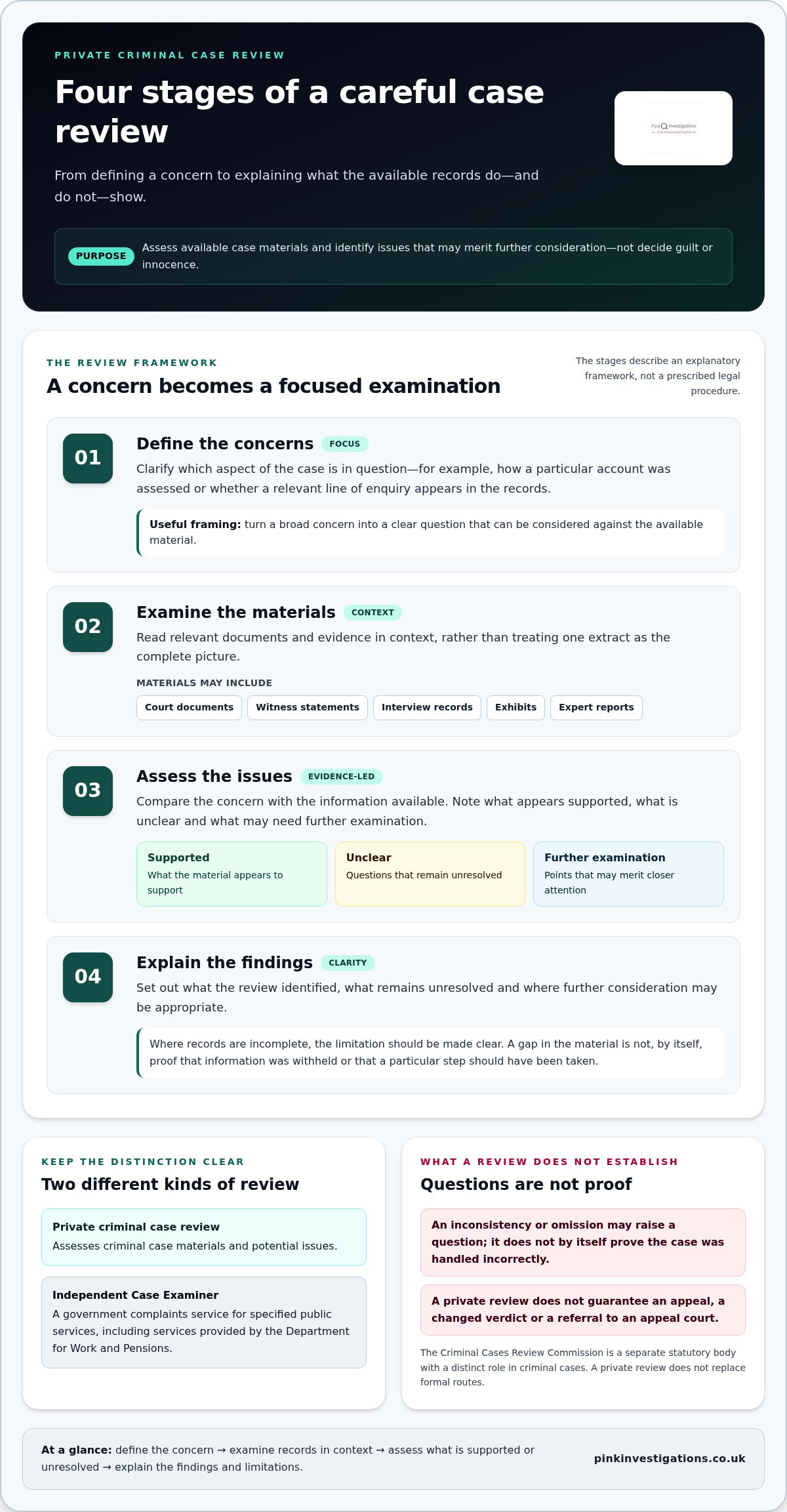
A careful review turns a broad concern into a focused examination of the available case materials. The reviewer considers what the concern relates to, what the records show and whether unanswered questions merit further consideration. This is an explanatory framework, not a prescribed legal procedure or a promise that every case will follow the same sequence.
In practice, the work can be understood in four stages:
- Define the concerns. Clarify which aspect of the case is in question, such as how a particular account was assessed or whether a relevant line of enquiry appears in the records.
- Examine the materials. Read relevant documents and evidence in context, rather than treating a single extract as the complete picture.
- Assess the issues. Compare the concern with the available information, noting points that appear supported, unclear or in need of further examination.
- Explain the findings. Set out what the review has identified, what remains unresolved and where further consideration may be appropriate.
The reviewer’s task is not to start from an assumed conclusion. An inconsistency, omission or difference between accounts may justify a question, but it does not by itself prove that the case was handled incorrectly. The assessment should distinguish what the material establishes from what it merely raises as a possibility.
Which case materials may be relevant?
The relevant material depends on the concern being examined and what is available. It may include case documents, statements, interview records, evidence presented in court or reports prepared during the investigation. A reviewer considers how these items relate to one another and to the issue raised. Context matters: a passage read in isolation may appear significant, while the surrounding information could clarify its meaning or relevance.
Where records are incomplete, that limitation should be made clear. A review can identify what is present and what appears absent from the material examined. An apparent gap is not proof that information was withheld or that a particular step should have been taken.
How are concerns translated into review questions?
A general feeling that something was missed becomes more useful when expressed as a question that can be tested against the records. For instance, if someone is concerned that two accounts differ, a review can examine what the documents record about each account, whether the difference was addressed and whether the available evidence helps explain it. This keeps the assessment focused without treating suspicion as established fact.
Where appropriate to the circumstances, the findings may indicate that further investigative work or expert consideration could be relevant. The GOV.UK information on the Criminal Cases Review Commission explains the role of this separate public body in reviewing potential miscarriages of justice. A private assessment does not replace that body or decide whether a case should proceed through a formal route.
A case review can clarify what the available material supports, highlight unresolved issues and explain what may warrant further consideration, without predicting the outcome. For a discussion of how document review and evidence analysis can help structure concerns, see Pink Investigations’ case review support.
What an independent case review can, and cannot, do
A private review provides structured scrutiny when someone remains concerned about a criminal case. It may clarify whether the available material raises questions that deserve further consideration and explain what those questions are based on. This can be valuable when the issues feel difficult to organise, but it is not a finding by a court or a formal review body.
An independent case review UK does not guarantee that an appeal will be allowed, that a conviction or sentence will change, or that new evidence will be found. A sound assessment is guided by the material available and reports its limits as clearly as its observations.
What can a review contribute?
A fresh assessment may bring an evidential concern, an apparent inconsistency or an unanswered question into clearer focus. For example, a reviewer may identify that the records do not explain how a particular issue was addressed. That observation can help define what might merit further consideration; on its own, it does not establish that an error occurred or prove innocence.
Findings depend on the review’s scope, the documents and evidence available, and the context in which they arose. If relevant material is missing or a concern cannot be resolved from the records, that uncertainty should remain visible in the assessment rather than being presented as a conclusion.
What decisions remain outside a private review?
A private reviewer cannot quash a conviction, direct a court or decide whether an appeal should succeed. Investigative assessment is distinct from legal representation: it can identify and explain issues, while formal decisions belong to the courts or the relevant public review body. Any next step depends on the circumstances and the applicable process.
In England, Wales and Northern Ireland, the Criminal Cases Review Commission considers applications concerning potential miscarriages of justice. Its role and remit are separate from a privately commissioned review; current information is available from the Official CCRC Website. Routes differ across jurisdictions, so a reference to the Commission should not be read as covering every part of the UK or every type of case.
Legal advice may be needed before deciding whether to pursue a formal application or appeal, particularly where a time limit or eligibility requirement could apply. These matters depend on the case and relevant jurisdiction. Check current authoritative guidance rather than inferring the position from a private review’s findings.
The practical value of a review is measured, not predictive. It can help set out what the evidence supports, what remains uncertain and which issues may warrant attention, giving the person and their legal adviser a clearer basis for considering possible next steps. It cannot determine the outcome of those steps.
When to review and how to prepare for initial discussion
People may consider fresh scrutiny when a concern about a criminal case remains unresolved. This could relate to how evidence was interpreted, whether a line of enquiry appears to have been followed, or how a particular issue was addressed during the case. These concerns can be difficult to assess alone, especially when relevant information is spread across many documents.
Seeking an independent case review UK does not mean that an appeal is necessarily available or that a mistake has occurred. An initial discussion helps clarify the concern and its context, then consider whether a structured assessment of the available material may be useful. Every case is individual, and examples of possible concerns do not establish grounds for an appeal.
What concerns might lead someone to seek a review?
A person might want to understand whether a particular piece of evidence was considered alongside other material, or why an apparent difference between accounts was not addressed in the records. They may also be concerned that a relevant investigative step is not apparent from the information they have seen. These are starting points for questions, not conclusions about the quality or fairness of a case.
Time passing, on its own, does not show that a case was mishandled. Nor does a troubling detail automatically demonstrate that a conviction should be challenged. A measured review considers the specific concern in context and avoids reaching conclusions before examining the available information.
What helps make the first conversation focused?
A concise outline can make an initial discussion more manageable. It need not be a complete account of every event. Consider noting:
- The main concern: identify the point you would like examined as clearly as you can.
- The context: explain when or where the issue arose in the case, and why it remains unresolved for you.
- Your questions: state what you hope a review might clarify, without assuming what its findings should be.
- Available material: indicate, at a high level, which case documents or evidence you already hold.
You don’t need to organise every record before starting a conversation. A broad sense of what is available can help identify what may be relevant; detailed document gathering can be considered later if appropriate. Keep clear what you know from the records and what you suspect or want to understand.
Pink Investigations offers a free 30-minute consultation to discuss your circumstances and the questions you want considered. You do not need to arrive with a settled view of the case or a particular outcome in mind. You can arrange a case review consultation to explain your concerns and consider a measured next step.
How Pink Investigations supports an independent case review in the UK
A review is most useful when its scope is clear, concerns are examined against the available material, and the findings are explained without assuming what they should show. Pink Investigations provides case review and appeals support through document reviews, evidence analysis and preparation of expert materials. The focus is shaped by the circumstances of the case.
This support is investigative in nature. It helps bring relevant documents and evidential questions into an organised assessment, but it does not replace legal advice or determine the outcome of an appeal. Findings are based on the material reviewed and should be understood within that scope.
What Pink Investigations brings to a case review
Pink Investigations examines case documents and relevant evidence in context, considering how the materials relate to the concerns raised. Director Susie is a former Police T/Detective Inspector with decades of experience, including a trading standards background. This investigative experience informs a careful assessment, but it is not a prediction or guarantee of a legal result.
Pink Investigations Ltd is a member of the World Association of Professional Investigators, is Public Indemnity insured and is registered with the Information Commissioner’s Office (ICO). These professional and organisational details do not alter the limits of a private review or confer decision-making powers over a court or public body.
A discreet first step to discuss the case
The free 30-minute consultation gives you time to outline the circumstances, identify the main concern and discuss a possible scope for review. You do not need to arrive with a complete explanation or a fixed view of what the evidence means. A clear account of what you want examined can help keep the discussion focused.
Each matter should be considered on its own information and context. A measured discussion can help distinguish questions a document review or evidence analysis may address from issues that require legal advice or a formal decision. It can also clarify which materials may be relevant to a wider assessment.
An independent case review UK should be approached as a careful examination, not as assurance that an appeal will be secured or a verdict changed. Pink Investigations assesses the available case materials and explains the findings in a considered way. If the review identifies questions, they can be described without treating them as proof of a miscarriage of justice.
If you would like to discuss your circumstances and the concerns you want considered, arrange a free 30-minute consultation with Pink Investigations.
Take a considered next step
Deciding whether an independent case review UK is appropriate can feel difficult when the concerns are personal and the possible next steps are uncertain. You don’t need to reach a conclusion before discussing it. A calm, focused conversation can help you explain what is troubling you and consider whether an independent assessment may be useful.
Approach a review with care and realistic expectations. Its value lies in examining the available information objectively, not promising a particular legal result. Pink Investigations’ work includes investigative oversight, with each matter considered on its own circumstances.
If you’re ready to discuss your situation, arrange a free 30-minute case review consultation. Take the first step at your own pace, with space to explain your concerns and consider a measured way forward.
Frequently Asked Questions
What is an independent case review in the UK?
It is a private assessment of criminal case information, focused on concerns about how evidence or issues were handled. For example, a review may consider whether the case papers address a particular inconsistency or investigative decision. The reviewer’s observations depend on the agreed scope and the material available. This is distinct from a court appeal or an application to a public body, each of which has its own process.
Is an independent case review the same as the Independent Case Examiner?
No. The Independent Case Examiner deals with complaints about certain government services, including services provided by the Department for Work and Pensions. A private criminal case review examines case material and concerns relating to a criminal matter. If your concern is about a public service’s handling of a complaint, the Examiner’s remit may be relevant; it is not a route for reassessing criminal evidence or a conviction.
Can an independent case review lead to an appeal?
A review may help clarify issues that a person wishes to discuss with a solicitor, but it does not itself lodge an appeal or decide whether one can proceed. For instance, an assessment might identify a question about how a piece of evidence was treated. Whether that question has legal significance, and what formal options may be open, requires consideration under the applicable rules. Don’t rely on a private review to protect a deadline.
What evidence is considered in a criminal case review?
The materials considered depend on the concerns and what is available. They may include relevant case papers, witness accounts, interview records, exhibits or expert reports. A reviewer might compare passages in two statements or examine whether a document records how a disputed point was addressed. Read material in context: a single extract may not show the full significance of an issue. Missing information can limit what can be concluded.
How long does an independent criminal case review take?
There is no single timescale that applies to every review. The amount and organisation of material, the questions being examined and the agreed scope can all affect how long the work takes. A focused assessment of a defined issue differs from a review involving extensive case papers. Discuss the proposed scope, fee basis and how findings will be communicated before work begins, rather than assuming a standard completion date.
Does an independent case review guarantee a miscarriage of justice will be found?
No. A review cannot guarantee that a miscarriage of justice will be identified, and raising a concern does not establish that one occurred. The findings may support a concern, leave it unresolved or show that the available material does not substantiate it. A careful assessment distinguishes documented facts, reasonable questions and matters that remain uncertain, so the limits of what has been examined are clear.
Who can request an independent review of a criminal case?
A person with concerns about their criminal case can make an initial enquiry about a private review. A family member may help explain the circumstances, although access to confidential case information may require the person’s involvement or appropriate authority. This private assessment is separate from applying to the Criminal Cases Review Commission, which has its own remit and application process. The relevant route depends on the case, jurisdiction and purpose of seeking review.
