

What if a complex criminal case needs a focused investigative review, rather than another legal opinion? Solicitors bring essential legal analysis and strategic direction, but large volumes of material can make it difficult to examine every evidential lead in depth. Case review solicitor support can add structured investigative scrutiny without duplicating or replacing the solicitor’s role.
For legal teams, the value lies in clearly defined tasks: organising case documents, comparing accounts, identifying points that may warrant further enquiry and preparing evidence analysis or expert materials. These findings can inform the solicitor’s assessment, whilst legal advice, decisions on case strategy and representation remain with the solicitor.
This guide explains how to coordinate document review, evidence enquiries and reporting, and how to assess whether investigative scrutiny is appropriate for a criminal matter. It also sets out the boundaries between investigative and legal work. At Pink Investigations Ltd, case review work is led by director Susie, a former Police T/Detective Inspector with policing and trading standards experience.
Key Takeaways
- Case review solicitor support can add investigative scrutiny to a criminal matter whilst legal advice, advocacy and case strategy remain with the solicitor.
- Define a specific factual or evidential question to keep document analysis and further enquiries focused and proportionate.
- Compare legal review, investigative review and coordinated support to assess what the case requires.
- A clear brief should identify priorities, relevant materials, scope and reporting requirements without prejudging findings.
- Pink Investigations Ltd provides case review, evidence analysis and expert-material preparation, drawing on director Susie’s former Police T/Detective Inspector experience.
Case review solicitor support: where independent investigation fits
Case review solicitor support is investigative assistance that helps a legal team examine material and address defined factual or evidential questions. It complements the solicitor’s work; it does not replace legal advice, advocacy or solicitor-led case strategy. The solicitor remains responsible for assessing the legal relevance of information and advising the client about available routes.
The distinction is practical as well as professional. A solicitor may identify an issue that needs closer factual examination, such as an unclear sequence of events or a discrepancy between accounts. An investigator can examine that issue within an agreed scope and report findings for the solicitor to assess.
Investigative analysis examines information; legal representation advises and acts for the client.
What independent case review support can mean
Investigative support may involve a structured examination of case documents, evidence and specific questions. The work starts with the material and instructions provided, then focuses on what can be established, what remains uncertain and whether a further enquiry may be relevant. The broad concept of a Legal case provides context, but each review should be shaped around the matter and its evidential issues.
For example, instructions might ask for a chronology to be checked against statements and other supplied documents, or for a particular inconsistency to be examined. A useful instruction identifies the records to compare and the question the comparison should answer. The purpose is not an unrestricted search, but a defined task with findings that can be assessed. Scope depends on the case and the instructions received.
A review may clarify existing material without producing new evidence. Any finding, including an absence of supporting information, should be reported accurately. Investigative work cannot promise that new evidence will emerge or that an appeal will succeed.
How the investigator and solicitor’s roles differ
The solicitor provides legal advice and representation, considers procedural decisions and guides the client on the legal significance of the material. The investigator’s role is distinct: to gather or examine information within the agreed instructions, analyse evidence and communicate findings clearly. The investigator does not decide the client’s legal position or direct the solicitor’s strategy.
That separation helps keep each contribution clear:
- The solicitor identifies the legal issues, advises the client and decides how investigative findings fit the case.
- The investigator examines specified material or enquiries and reports what the work supports, including uncertainties or limitations.
- The legal team uses the findings as part of its own assessment, rather than treating them as a substitute for legal judgement.
Clear boundaries also help avoid duplicated effort. The solicitor can set the question and retain control of legal decisions, whilst investigative scrutiny provides a focused account of relevant information. This gives the legal team a structured basis for further assessment without prejudging what the evidence means or what outcome may follow.
What investigative case review support can contribute to a solicitor’s case
Case review solicitor support can turn a broad concern about a case into a defined investigative task. The solicitor identifies the factual or evidential question; an investigator examines relevant materials or carries out a proportionate enquiry, then reports findings for the legal team’s consideration. A focused task helps keep the work relevant and avoids searching through material without a clear purpose.
Reviewing documents and evidence systematically
A useful review begins with clear instructions. Identify the documents to examine, the events or period in scope, and the question the review should address. The investigator can organise records into a chronology, compare accounts across documents, and flag apparent inconsistencies, missing information or points that may need clarification.
For example, if the instructions ask whether records support a particular sequence of events, the review can set out what each relevant document records and where accounts differ. That comparison may help the solicitor decide whether further legal assessment or enquiry is appropriate. An inconsistency alone does not establish a legal ground or determine the significance of the evidence. The legal team assesses its relevance in context.
The word “review” can describe different processes. Cornell Law School’s Legal Review Standards entry discusses judicial review, a legal process distinct from investigative examination of case materials. Keeping that distinction clear helps define what an investigator’s review can contribute without suggesting that it determines a court’s assessment.
When further investigative enquiries may be relevant
Further enquiries may be appropriate when a specific factual issue remains unresolved after the available material has been examined. The instructions should explain what needs clarification and why it matters to the solicitor’s assessment. Depending on the question, work may involve seeking relevant information or making enquiries connected to a person or event. Keep the scope proportionate to the issue rather than extending it to unrelated lines of enquiry.
Findings should record what was established, what remains uncertain and any limitations affecting the enquiry. A clear report gives the legal team a basis for deciding whether the issue warrants further consideration. It does not determine the legal position or guarantee that additional evidence will be found.
Other investigative tasks can be similarly bounded. Evidence analysis may compare a specific account with supplied records, whilst preparation of expert materials can support the presentation of relevant findings. In each instance, the solicitor’s question guides the work, and the output is information for legal assessment rather than legal advice.
For instance, a solicitor might ask whether a date in one record aligns with the sequence shown in other supplied documents. A reviewer could map the references, note any discrepancy and report what the material does and does not establish. This is an illustrative workflow, not a claim about a particular client matter or outcome.
Where a criminal matter would benefit from structured document review or evidence analysis, Pink Investigations’ case review support can provide focused investigative input for the solicitor’s assessment.
Solicitor-led review or external investigative support: how to assess the fit
Choosing between solicitor-led review and independent investigative input depends on the question that remains. If the work is primarily to interpret legal issues or consider procedural options, that is for the solicitor. If a specific factual point needs structured examination, case review solicitor support may provide useful additional scrutiny. Not every conviction or appeal requires an investigator; the decision should reflect the needs of the case.
| Approach | Main contribution | Responsible for |
|---|---|---|
| Solicitor-led review | Legal analysis of the case and relevant material | Legal advice, representation and procedural decisions |
| Investigative review | Examination of defined evidence or factual questions | Information gathering and reporting findings within the agreed scope |
| Coordinated case support | Investigative findings considered alongside legal analysis | The investigator reports; the solicitor assesses legal significance and options |
Signs a focused independent review may be useful
Consider external scrutiny where the materials leave a defined factual question unresolved, or where the volume or arrangement of records makes a chronology or evidence analysis useful. For example, a solicitor may need a clear comparison of dates recorded in several documents before deciding whether the point merits further legal assessment. That is a reason to consider a focused review, not an indication that it will establish a legal ground or alter an outcome.
By contrast, if the remaining issue is solely how the law applies or which procedural route is available, the solicitor is best placed to advise. A measured assessment helps avoid commissioning investigative work simply because a case is complex or the outcome is serious.
Keeping the work complementary rather than duplicative
Duplication is less likely when the solicitor defines the question, identifies relevant materials and agrees what the report should address. The investigator can then distinguish direct observations from uncertainties and avoid presenting legal conclusions. The solicitor retains responsibility for deciding how the findings affect the client’s position and what steps, if any, to take.
This distinction is also useful when considering the broader meaning of independent case review in the UK. Clear instructions make the work easier to assess alongside the solicitor’s own review, whilst keeping its purpose proportionate to the issue at hand.
Before proceeding, the legal team can ask three practical questions: Is there a clear factual issue? Can the relevant material be identified? Could the findings assist the team’s assessment? If the answer to these questions is no, further investigative work may add little. External support is most useful when it addresses a defined factual or evidential question without taking over legal judgement.
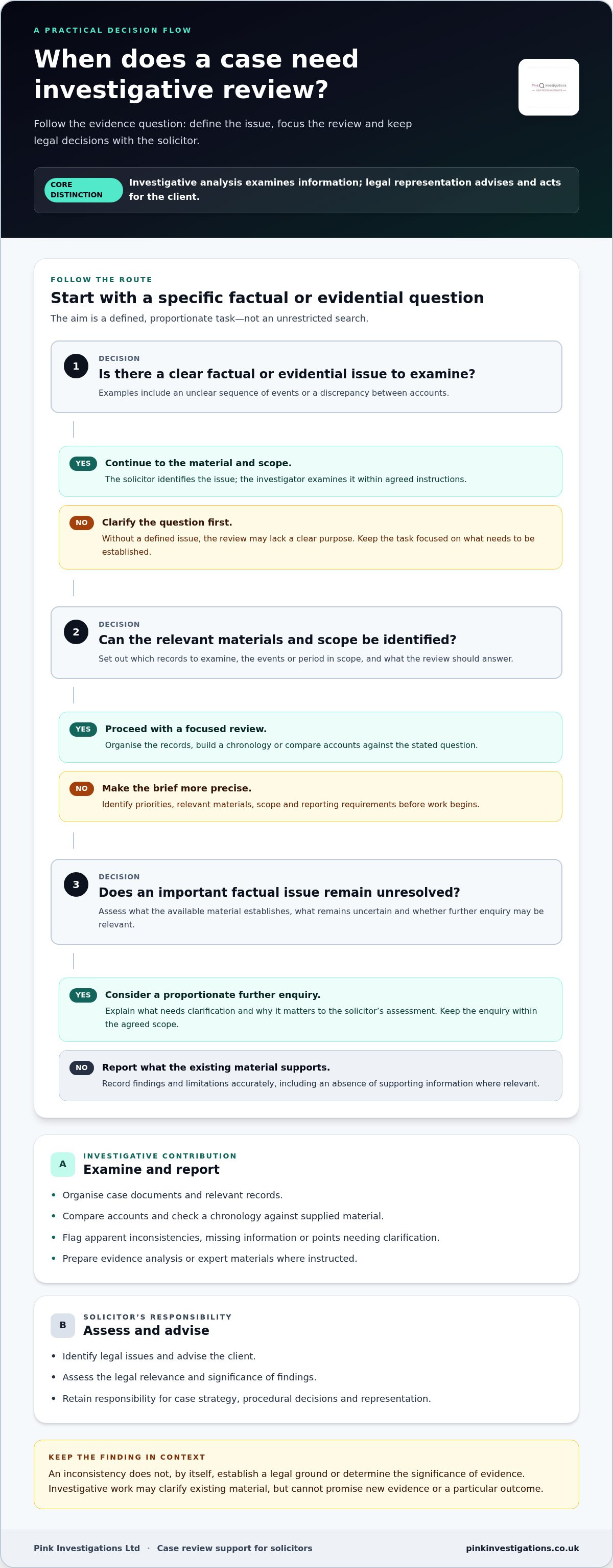
How solicitors can brief and coordinate a case review
A clear brief helps keep an independent review focused, proportionate and useful to the legal team. It gives the investigator a defined task, helps avoid unnecessary duplication and allows findings to be considered alongside the solicitor’s work. For effective case review solicitor support, agree the scope before material is examined and maintain coordination as the review progresses.
Preparing a clear instruction
Begin with a concise summary of the case background, the review objective and the evidential concern that requires attention. State what the solicitor needs to understand, not what the investigator should find. Neutral wording supports objective examination and leaves the conclusions open.
A practical sequence can help structure the instruction:
- Define the question. State the factual or evidential issue to be examined and why it matters to the solicitor’s assessment.
- Identify relevant material. List the documents or evidence in scope, explain how they relate to the question and note any known gaps or limitations.
- Agree the scope. Clarify whether the work is limited to document review and analysis or includes specified further enquiries. Record boundaries and priorities.
- Set the intended output. Explain the expected format and audience, such as a written account of observations, sources reviewed and unresolved points.
Keep instructions proportionate to the issue. If several concerns arise, prioritise them and distinguish the central question from matters outside scope. This gives the investigator a clear basis for working and makes it easier to discuss whether a proposed enquiry remains relevant as the review develops.
Case materials may contain sensitive personal information. Before sharing them, the solicitor should consider how the material is to be handled and ensure that the proposed arrangements are consistent with applicable confidentiality, data protection and professional obligations. Requirements depend on the circumstances, so the legal team should consider them before sharing or using the material.
Managing findings and next steps
Agreeing how findings will be presented is as important as defining the initial question. A useful report distinguishes information found in the source material from interpretation, records the context needed to understand each observation, and identifies any limits in the review. This allows the solicitor to assess the material without treating an investigative observation as a legal conclusion.
Once the findings are received, the solicitor can decide whether they warrant further legal assessment, a narrowed follow-up enquiry or no further action. An investigative report does not determine appeal prospects, establish a legal ground or select a procedural route. Those decisions remain with the solicitor, who can advise the client on the significance of the findings and any options available.
For solicitors seeking structured investigative input, arrange a case review discussion with Pink Investigations to consider a clearly scoped instruction and the material relevant to it.
Pink Investigations’ case review support for solicitors
Pink Investigations Ltd provides case review and litigation support for solicitors handling complex criminal matters. Its work includes structured document review, evidence analysis and preparation of expert materials. Each instruction is shaped around the solicitor’s question and an agreed scope, directing the investigative work towards a specific issue rather than an open-ended examination of the case.
This case review solicitor support complements the legal team’s work. Findings can help organise relevant information, identify matters that may need further enquiry and provide material for the solicitor’s assessment. Pink Investigations does not provide legal advice or representation, and investigative findings do not determine an appeal’s prospects or outcome.
An experienced investigative perspective
Director Susie is a former Police T/Detective Inspector, with experience in policing and trading standards. That background provides investigative context when examining case material and considering how information can be organised and assessed. It does not make the review a legal opinion; the solicitor remains responsible for interpreting the legal significance of findings and advising the client.
Pink Investigations Ltd is a member of the World Association of Professional Investigators, ICO registered and Public Indemnity insured. Its investigative work focuses on the materials and questions within the agreed instructions, with findings presented for the legal team to consider.
Discussing a solicitor support brief
An initial discussion can help establish whether a case would benefit from investigative input and how to define the work appropriately. Solicitors can outline the matter, the review question and the relevant materials or evidential concerns. The potential scope can then be discussed in proportion to the issue, including the type of review or analysis that may assist and how findings could be presented.
A clear brief also supports a measured working relationship. The solicitor identifies priorities and retains control of legal decisions, whilst the investigator focuses on the agreed task. If the initial question changes as material is reviewed, the scope can be discussed with the solicitor rather than allowing the work to expand without direction.
Pink Investigations offers a free 30-minute consultation for solicitors to discuss a potential case review instruction. Arrange a consultation to outline the matter and consider a proportionate investigative scope, without any presumption about what the findings will show or what outcome may follow.
Give the next investigative step a clear purpose
Where a defined factual question remains, decide whether independent scrutiny could help your team assess it. A focused brief keeps the work proportionate and helps ensure that findings are considered alongside, not in place of, your legal analysis. This is the practical value of case review solicitor support: a structured way to examine a specific issue without prejudging what the evidence may show.
If you’re considering an investigative review, use an initial discussion to outline the matter, the question you need examined and the relevant material. Pink Investigations Ltd offers a free 30-minute consultation to discuss whether a proportionate investigative scope may assist your work.
Arrange a free 30-minute consultation and take the next step with a clear, considered approach.
Frequently Asked Questions
What does case review solicitor support involve?
Case review solicitor support involves commissioning investigative work to examine a defined issue in a criminal case. This may include reviewing selected records, analysing evidence or making a focused enquiry where a factual point remains unclear. For example, a solicitor might request a comparison of how a particular event is recorded across several documents. The investigator reports the work and its limits, leaving legal assessment with the solicitor.
Can a private investigator help a solicitor with a criminal appeal?
Yes. An investigator can support a solicitor by examining case materials or making targeted enquiries relevant to a matter being considered for appeal. The solicitor should identify the factual question and determine whether investigative work may assist their assessment. An investigator cannot act as the client’s solicitor, select an appeal route or guarantee that evidence will support an appeal. The value lies in providing carefully reported information for the legal team to consider.
What is the difference between a case review and legal advice?
An investigative case review examines information and reports factual observations, such as what a record states or where accounts differ. Legal advice applies the law to the circumstances and guides the client on their position and options. An investigator may identify a discrepancy between two supplied records, but only the solicitor can advise whether it has legal significance or affects a procedural decision.
When should a solicitor consider independent case review support?
Consider it when a specific factual question may be clarified through structured examination or a targeted enquiry. This could arise where key dates differ across records or where an account needs to be checked against other material. Independent input is not necessary for every criminal matter. The solicitor can assess whether a defined investigative task would add useful information beyond the work already completed.
What documents should a solicitor provide for a case review?
Provide the material relevant to the agreed question, rather than an unstructured bundle where possible. Depending on the task, this might include selected statements, exhibits, correspondence, records or an existing chronology. A brief index and clear identification of document versions can help prevent confusion. The solicitor should explain known gaps or context needed to interpret the material, and consider appropriate arrangements for sharing sensitive information.
Can an investigator advise whether a conviction will be overturned?
No. An investigator cannot determine whether a conviction will be overturned or advise on the legal prospects of an appeal. Investigative work may identify information for the solicitor to assess, but it cannot predict a court’s decision or guarantee a particular result. The solicitor is responsible for explaining the legal significance of the findings and advising the client about relevant options. Any report should describe evidence and limitations, not promise an outcome.
How can a solicitor brief an investigator for a case review?
Set out the case background, the precise question to be examined and why it matters to the review. Identify relevant documents, any specific enquiry requested, and the form of report or material needed. For example, ask for a chronology of named records rather than an unrestricted search for inconsistencies. Keep the instruction neutral, state any boundaries, and agree how sensitive materials will be handled before sharing them.


