

Could a conviction deserve closer examination without confusing a private review with an appeal? If you’re considering a criminal case review UK support can help assess the evidence, case handling and available materials. However, a private review cannot overturn a conviction or refer a case to an appeal court.
It’s understandable to feel uncertain about whether something was missed, which route applies or whether a deadline has passed. A private review and a statutory commission have different roles. Investigative support can examine documents, analyse evidence and help prepare expert materials. The relevant commission decides whether a case may be referred to an appeal court. A review can clarify questions and possible next steps, but it cannot guarantee a different outcome.
This article explains what a private review may examine, how it differs from the CCRC and SCCRC, and why the right process depends on whether the case arose in England and Wales, Northern Ireland or Scotland. It also covers appeal history and timing, so you can approach your next decision with clearer questions and measured expectations.
Key Takeaways
- A criminal case review UK can help organise concerns about evidence and case handling into a structured assessment.
- Understand the different roles of private reviewers, the CCRC and appeal courts before deciding which route to explore.
- Keep relevant case materials together and note the specific unanswered questions you want examined.
- Your appeal position and the jurisdiction where the case was heard can shape sensible next steps.
- Pink Investigations can support a case review through document review, evidence analysis and preparation of expert materials.
What does a criminal case review in the UK mean?
A criminal case review is a structured reassessment of available case materials, evidence and investigative steps. It may examine whether a concern is supported by the wider record, whether relevant lines of enquiry were pursued, or whether information was handled or disclosed in a way that warrants closer scrutiny. The purpose is to assess the issues carefully, not to reach a fresh verdict.
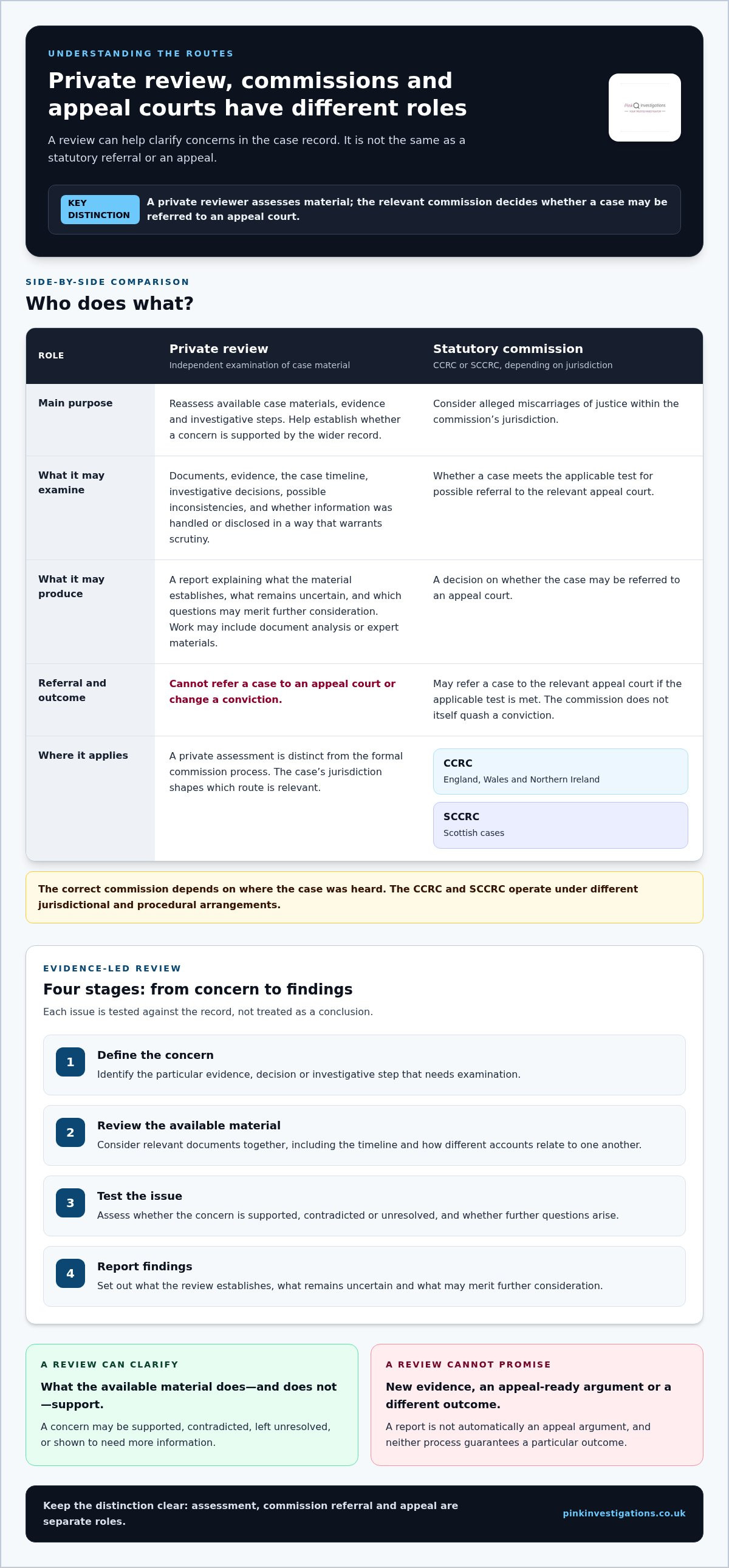
The phrase criminal case review UK can describe different processes. A private review involves an independent examination of case materials and may help identify questions or potential grounds for further legal consideration. It is not a formal appeal: a private investigator cannot change a conviction or refer a case to an appeal court. A statutory commission has a separate public role and may refer a case to the courts if the applicable test is met. Neither process guarantees a particular outcome.
What can prompt someone to revisit a criminal case?
Someone may seek a closer examination because of concerns about the reliability of evidence, an investigative step that appears incomplete, material they believe was not disclosed, or information that may have been misunderstood. These concerns call for careful assessment, particularly when the consequences of a conviction continue to affect a person and their family.
Each issue needs to be considered in the context of the whole case. A statement that seems inconsistent when read alone, for example, may be clarified by other evidence or the sequence of events. An unanswered investigative question may also warrant closer examination if it could have affected how the evidence was understood. Disagreement with a verdict, by itself, does not establish that a miscarriage of justice occurred.
Which UK body handles a possible conviction review?
The Criminal Cases Review Commission (CCRC) deals with possible miscarriages of justice in England, Wales and Northern Ireland. It can refer a case to the relevant appeal court, but it does not itself quash a conviction. The Criminal Cases Review Commission (CCRC) overview provides background on the Commission’s history and responsibilities.
Scotland has a separate body, the Scottish Criminal Cases Review Commission (SCCRC). It considers alleged miscarriages of justice in Scottish cases and may refer a case to the appropriate appeal court. The commissions operate under different jurisdictional and procedural arrangements. The correct route depends on where the case was heard, so consult the relevant commission’s current guidance before taking procedural steps.
A private review can help organise and assess concerns, but it remains distinct from a formal appeal and a commission’s statutory decision-making role. Its value is in clarifying what the available material does and does not support, so any further steps can be considered carefully and with realistic expectations.
How does a criminal case review examine evidence and possible errors?
A careful review follows a defined sequence, testing concerns against the record rather than treating them as conclusions. In a criminal case review UK, the work may be organised into four stages:
- Define the concern. Identify the particular evidence, decision or investigative step that needs examination.
- Review the available material. Consider relevant case documents together, including the timeline and how different accounts relate to one another.
- Test the issue. Assess whether the concern is supported, contradicted or left unresolved by the material, and whether further questions arise.
- Report findings. Set out what the review establishes, what remains uncertain and what may merit further consideration.
Context matters. A short extract may seem inconsistent with another account, but the full statement, its timing and related evidence may explain the apparent difference. Reviewers should distinguish a genuine discrepancy from one that can reasonably be understood in light of the wider record.
What does an evidence-led review look for?
An evidence-led review may consider whether important information appears incomplete, inconsistent or insufficiently examined. It can also assess investigative decisions against the chronology and available material. For example, an apparent gap may raise a relevant question about the sequence of events or how an account was handled.
Sound analysis separates documented facts from unresolved questions and professional opinion. This helps prevent a possibility from being presented as proof. The official Criminal Cases Review Commission (CCRC) website explains the Commission’s separate role. A private review assesses material but cannot itself change a court decision.
What might a reviewer produce?
A written report may summarise the material examined, explain how identified concerns were assessed and record further investigative questions. Where appropriate to the case, the work may include detailed document analysis or preparation of expert materials. These outputs can make complex information clearer and show which issues appear to be supported by the available evidence.
Not every review identifies new evidence, and a report is not automatically an appeal-ready argument. The findings may indicate that a concern is unsupported, that more information is needed, or that an issue warrants legal consideration. Each outcome calls for measured interpretation, not an assumption that the review will alter the result.
For an evidence-focused assessment of case materials, Pink Investigations Ltd’s criminal case review support can include document review, evidence analysis and preparation of expert materials.
Private case review or CCRC application: what is the difference?
A private review and an application to the Criminal Cases Review Commission (CCRC) may both involve examining a conviction, but they have different purposes. A private investigator can assess case materials and identify issues for further consideration. The CCRC is an independent statutory body with authority to refer qualifying cases to an appeal court. Neither route guarantees a new appeal or a changed conviction.
| Area | Private case review | CCRC application |
|---|---|---|
| Purpose | Examine material and assess specific concerns or investigative questions. | Consider whether a case should be referred to an appeal court for a fresh appeal. |
| Decision-making authority | No power to decide an appeal, quash a conviction or refer a case to court. | Can refer a qualifying case; the appeal court decides the appeal. |
| Likely output | Findings about the material reviewed, including issues that may need further consideration. | A decision on whether to refer the case, or not to refer it. |
| Relationship to appeal routes | May help clarify issues before legal options are considered. | Generally considers applications after an appeal has been dismissed, with exceptional circumstances for cases without a prior appeal. |
What authority does the CCRC have?
The CCRC reviews possible miscarriages of justice and, where its statutory test is met, refers a case to the relevant appeal court. It does not itself hear the appeal or decide whether a conviction should be overturned. To make a referral, the Commission applies the “real possibility” test: broadly, whether the conviction or sentence would be overturned on appeal. Its guidance sets out current application requirements and how the test applies to an individual case.
What can a private investigator contribute?
Within an agreed brief, an investigator can examine documents and evidence, assess identified concerns in context, and set out findings or unanswered questions. This work may help the individual or their legal team consider which options to explore. It is investigative support, not legal advice or appeal representation. Private investigators have no CCRC or court powers.
Commissioning a private review does not guarantee that the CCRC will refer a case or that an appeal will succeed. A review may identify a relevant issue, but it may also find that the available material does not support the concern or that further information is needed. Treat the findings as an assessment to inform next steps, not as a prediction or determination of the court’s decision. For anyone considering a criminal case review UK, keeping the investigative assessment distinct from formal legal decisions helps set realistic expectations.
When should you consider a criminal case review, and what comes next?
A closer assessment may be worth considering when you can identify a specific concern, have relevant case materials, or are unsure whether an investigative question was properly examined. You don’t need to know in advance whether the issue meets an appeal or referral threshold. Start by describing the concern clearly and considering it against the case record, rather than treating suspicion alone as proof.
What circumstances may justify a closer assessment?
Possible reasons include evidence that appears materially inconsistent, an investigative step that may not have been followed up, or information you believe was not adequately considered. The importance of an issue depends on how it relates to the proceedings as a whole. A concern that seems significant in isolation may look different alongside the full record, and no particular issue automatically establishes grounds for an appeal.
How can you approach an initial discussion?
Prepare a short, factual account covering the conviction or sentence, where and when the case was heard, any appeal already made and its outcome, and the main concern you want examined. Note whether an appeal is ongoing or a procedural decision is pending. Jurisdiction matters because criminal processes and review routes differ across England and Wales, Northern Ireland and Scotland.
If a court deadline, ongoing appeal or other procedural decision may be involved, seek legal advice promptly. A private investigative review does not pause or replace court procedures. An application to a statutory commission is also distinct from private review support, so understanding your current position can help you decide which route to explore.
Keep your preparation proportionate. If available, gather the key documents that relate directly to your concern, such as relevant correspondence, decisions or evidence referred to in the case. A complete file may take time to assemble, but a concise outline of what you know and what remains unanswered can help structure an initial conversation. Avoid altering original records, and distinguish what you have personally observed from what you have been told.
Pink Investigations Ltd offers a confidential 30-minute consultation to discuss the circumstances and the concerns you have identified. The conversation can help establish what you want to understand without assuming a review will change the result. Read about Pink Investigations Ltd.
How Pink Investigations supports criminal case reviews
Pink Investigations Ltd provides criminal case reviews and appeals support for people seeking a careful assessment of concerns about a conviction or sentence. The work can include reviewing case documents, analysing evidence and preparing expert materials where appropriate. Each review is shaped around the available material and the questions to be examined, rather than assuming in advance that an error or appeal ground will be found.
Experienced investigative oversight is central to this work. Director Susie is a former Police T/Detective Inspector with policing and trading standards experience. Pink Investigations Ltd is a member of the World Association of Professional Investigators, Public Indemnity insured and ICO registered. These details provide context for the professional framework in which case materials are handled and assessed.
What does Pink Investigations Ltd bring to a case review?
A criminal case review UK may involve a substantial and complex record. Pink Investigations Ltd takes a structured approach, focusing on the concerns raised and assessing them against the available documents and evidence. The review can help distinguish established information from unresolved questions, giving you a clearer basis for considering what may merit further attention.
Each matter is considered individually and handled with discretion. Findings are not predetermined: a review may identify issues for further consideration, or conclude that the material examined does not support a particular concern. Investigative findings can inform an individual or legal team, but they do not replace legal advice or decisions by a court or statutory commission. No review can promise an appeal, a referral or a changed outcome.
Pink Investigations Ltd offers a free 30-minute consultation to discuss the circumstances and the concerns involved. The company also states 24/7 availability. The consultation provides a starting point for a measured discussion about the case, without making assumptions about what an investigation will establish.
What is a sensible next step?
For an initial discussion, it can help to outline the conviction or sentence, your current appeal position, where the case was heard and the main issue you want examined. You don’t need to arrive with a complete explanation or a conclusion. A clear account of what is known, what remains uncertain and which materials are available can help establish whether investigative review support is relevant to your circumstances.
The purpose of that first conversation is to consider the scope of the concern and the possible role of a review. It cannot determine whether a court will hear an appeal or how a formal process will decide the case. Those outcomes depend on the evidence, applicable legal tests and decisions made through the proper legal process. A careful assessment can still give you a more organised understanding of the material and possible next questions.
To discuss your circumstances with Pink Investigations Ltd, arrange a free 30-minute consultation.
Move towards a clearer next step
Choosing to revisit a conviction is a personal decision. It can be difficult to know where to focus when the case has been part of your life for a long time. You don’t need to have every document organised or know in advance which route is right. A clearly stated concern is a useful place to begin.
Focus on what you need greater clarity about, rather than reaching a conclusion before the material has been assessed. This helps keep a criminal case review UK centred on your actual concerns and expectations measured. The aim is to make your next decision with better-defined questions, not to promise a particular result.
If you’re ready to consider whether investigative support could help clarify your position, arrange a confidential discussion. Taking one considered step at a time can make a complex situation feel more manageable.
Frequently Asked Questions
Is there a time limit for asking the CCRC to review a criminal case?
No, there’s no time limit for applying to the CCRC. This is separate from deadlines that may apply to court appeals or other legal steps, so the absence of a CCRC deadline does not mean every route remains open indefinitely. If a court deadline is approaching, or an appeal is under way, seek legal advice promptly. The Commission’s current application guidance can help you understand its process.
Can I apply to the CCRC without a solicitor?
Yes, you can apply without a solicitor. Before applying, review the CCRC’s current guidance on eligibility and the information to provide. In most cases, an appeal must already have been dismissed; the Commission considers cases without a prior appeal only in exceptional circumstances. A clear account of the appeal history and the matters you want considered can help explain your application. Legal advice may be useful if you’re uncertain about your position.
How long does a criminal case review take in the UK?
There’s no single timeframe for a criminal case review UK. The duration can depend on the complexity of the case, the volume of material and whether further enquiries are needed. A private review and a CCRC application are separate processes, so their timescales may differ. If a court deadline or live legal process is involved, don’t wait for a review to finish before seeking advice about that time-sensitive issue.
Can a family member apply for a CCRC review on someone else’s behalf?
A family member can help someone prepare an application or make an enquiry on their behalf, but should establish what consent or authority the CCRC requires before submitting personal information. If the person concerned can take part, involve them in explaining the case and the points they want examined. If they cannot manage the process themselves, consult the Commission’s current guidance about applications made by a representative.
Does the CCRC review criminal cases in Scotland?
No. The CCRC covers cases from England, Wales and Northern Ireland. For a case heard in Scotland, the relevant body is the Scottish Criminal Cases Review Commission (SCCRC), which has a separate process. Start by identifying where the case was heard, rather than where you live now, then consult the relevant commission’s current guidance. This helps avoid preparing an application for the wrong jurisdiction.
How much does a private criminal case review cost?
Private review fees depend on the work involved, so there isn’t one standard cost for every case. Pink Investigations undertakes case review and appeals support on an hourly or fixed-fee basis, depending on the engagement. The time required may be affected by the amount of material and the questions to be examined. A free 30-minute consultation is available to discuss the circumstances and potential scope of the work.
Can a private case review overturn a conviction?
No. A private case review cannot overturn a conviction, change a court decision or refer a case to an appeal court. Its role is investigative: findings may help clarify evidence or identify questions for further consideration. Any formal appeal is decided through the courts, and any CCRC referral decision belongs to the Commission. Treat a private report as an assessment of material, not a promise of a legal outcome.