

A large case file can seem comprehensive while making important details difficult to find. Learning how to review evidence for an appeal means testing each item against the full case record, rather than relying on first impressions or treating suspicion as fact.
If you’re unsure what the evidence establishes, where accounts differ or whether something has been overlooked, a structured review can help. It can organise the material, separate recorded facts from interpretation and identify gaps or potential fresh evidence for careful consideration.
This guide explains how to review documents, witness accounts and other case material, and why context and consistency matter. Appeal routes and legal tests vary across the UK, so appropriate legal advice remains important. Specialist case-review support can help organise and analyse complex evidence, but it does not replace legal representation or determine the outcome of an appeal.
Key Takeaways
- Learn how to review evidence for an appeal by checking each item’s source, date, relevance, corroboration and limitations against the case record.
- Keep contemporaneous records, witness accounts, expert material and later interpretations distinct so their roles and reliability can be assessed fairly.
- Record inconsistencies and possible fresh evidence carefully. Importance alone does not establish that material can be admitted or will affect an appeal.
- Use a consistent checklist to note document references, origins and unresolved questions. Preserve originals alongside clearly identified copies.
- Independent case-review support can help organise complex evidence, while legal advice and representation remain separate and essential.
How to review evidence for a criminal appeal: purpose and scope
A criminal case file may contain statements, records, exhibits and expert material gathered at different stages. Reviewing it means examining how those items fit together and identifying matters that may need further attention. It is not a prediction of what a court will decide and cannot guarantee that an appeal will succeed.
Evidence review is a structured examination of case material to understand what it records, how it relates to the proceedings and what questions remain. It is not legal advice, a formal appeal decision or a substitute for either.
This distinction matters. An apparent omission, inconsistency or unanswered question may be worth recording, but identifying a concern does not by itself establish a legal ground of appeal. A legal representative can assess whether it relates to the applicable appeal test and advise on procedure. A careful review can make that assessment more focused by showing precisely what the material says and what it does not establish.
What does reviewing appeal evidence involve?
For each item, establish what it records, who created or supplied it, when it was produced and how it entered the case. Compare it with related material and the account presented at trial. A record might support one part of a witness’s account, conflict with another part or leave a point unresolved. Keep these possibilities distinct: a discrepancy is not, by itself, proof that an account is false.
Separate the recorded fact from the inference drawn from it. For example, a custody record may show that a person was booked in at a stated time. On its own, it does not establish where that person was before arrival or whether the time is accurate. Note the source and its limitations, then identify what further material or clarification might answer the question. Apply the same fair-minded approach to documents that appear helpful to either side.
Which appeal context does this guide cover?
This guide concerns criminal convictions and post-conviction case review. It does not explain appeals against benefit decisions, where tribunal processes and relevant evidence may differ, or civil appeals, which follow their own procedures. Guidance from the Crown Prosecution Service concerns appeal procedures in England and Wales. It should not be read as guidance on benefit tribunal appeals or every criminal appeal route.
Routes and rules differ across England and Wales, Scotland and Northern Ireland. In England and Wales, the Court of Appeal of England and Wales is one part of the criminal appeal system, but not every case follows the same route to that court. The court, procedure, applicable test and time limits depend on the circumstances and jurisdiction. Obtain advice from a qualified legal professional familiar with the relevant jurisdiction before relying on a deadline or deciding how to proceed. Evidence analysis can help organise the record, but it cannot determine whether an appeal is legally available.
How to assess each item of evidence against the case record
A consistent method makes a large file easier to review and reduces the risk of focusing only on material that supports one interpretation. Assess each item against the wider case record. Note what it contributes, what it conflicts with and what remains uncertain. Evidence should be assessed in context, not isolation: its meaning depends on its source, timing, relationship to other material and limitations.
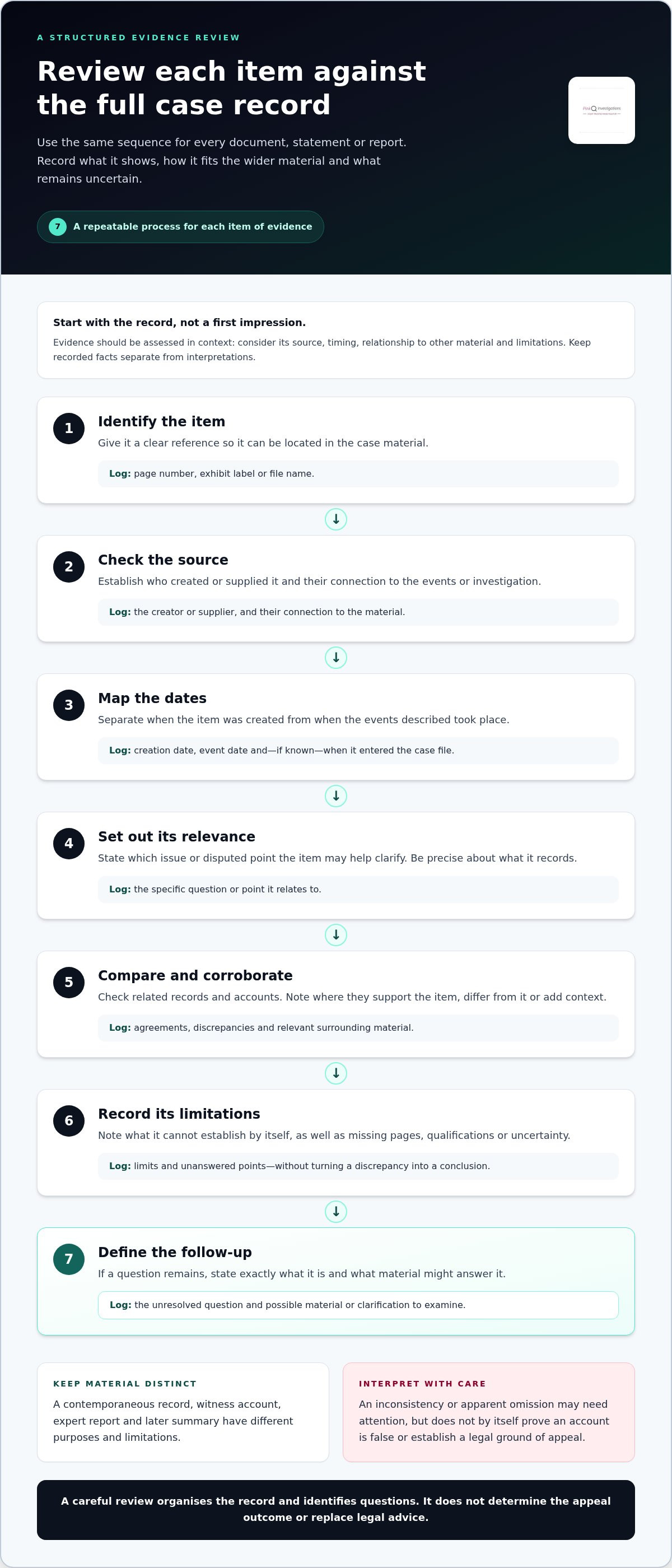
Use the same sequence for each document, statement or report. An evidence log can help you record your reasoning without turning an initial impression into a conclusion:
- Identify: Give the item a clear reference, such as a page number, exhibit label or file name.
- Source: Record who created or supplied it and their connection to the events or investigation.
- Date: Note when it was created, when the events described took place and, if known, when it entered the case file.
- Relevance: State which issue or disputed point it may help clarify.
- Corroboration: Compare it with other records or accounts that support it, differ from it or add context.
- Limitation: Note what it cannot establish by itself, along with any missing pages, qualifications or uncertainty.
- Follow-up: Record the specific question that remains and what material might answer it.
Check source, timing and context
Classify the material before weighing it. A contemporaneous record, such as a dated log made close to an event, differs from a witness account, expert report or later summary. Each has its own purpose and limitations. Check whether you have the full document, an extract, a copy or a summary, and record where your version came from. A summary may omit detail, but that does not establish that the underlying record is inaccurate.
Compare dates and sequences with surrounding records. If two documents give different times, preserve both entries and note the difference rather than assuming misconduct or error. Consider whether they refer to separate stages, use different recording methods or were prepared at different times. Treat these as possible explanations to examine, not conclusions to adopt without support.
Test relevance, corroboration and limitations
Ask what precise question an item may help answer. A dated note might confirm that a conversation was recorded, but not prove that every detail recalled later is accurate. Compare witness accounts for material agreement and inconsistency, while allowing for plausible differences in perspective, memory or the questions asked. Record supportive and adverse material alike. A balanced log is more useful than one that collects only apparent discrepancies.
Flag unexplained differences, missing context and alternative interpretations for careful assessment. The aim is not to decide the appeal yourself, but to make the record clearer for legal consideration. A structured criminal case evidence review can help organise complex documents and identify questions requiring further attention, without replacing legal advice or representation.
Fresh evidence, inconsistencies and the limits of an appeal review
Material that was not before the trial court needs careful description before anyone can assess its significance. It may have come to light only after trial, or it may have existed at the time but not been obtained, disclosed or presented. These situations are not interchangeable. Nor does material become admissible or make an appeal successful simply because it appears relevant or potentially important.
An appeal does not always depend on evidence discovered after trial. A concern may relate to material already in the case record or another legal issue. Equally, new material does not guarantee that a conviction will be overturned. In England and Wales, section 23 of the Criminal Appeal Act 1968 concerns the reception of evidence in Court of Appeal proceedings. Its application and relevant authorities should be checked by a qualified legal adviser. Rules differ across the UK, so don’t rely on a general summary as the test for your case.
When and how it came to light, who can explain its origin, whether it can be independently checked and how it relates to the trial record.
When it was created, who held or knew about it, and any known reason it was not used. Avoid assuming why it was omitted.
The exact passages or records that differ, whether the difference is material, and any context or alternative explanation that may account for it.
How should newly discovered material be examined?
Start with provenance: note when it was found, the circumstances in which it emerged and who can explain where it came from. Preserve the original where possible, and record whether you hold an original, copy or later account of it. Then identify what it might confirm or challenge in the existing case record. A document’s apparent importance is not a legal ruling on whether a court can receive it. Record that as a question for a qualified adviser rather than labelling the material “admissible” yourself.
What can an inconsistency show, and what can it not show?
A difference between two accounts may matter if it concerns a central issue, but not every variation carries the same weight. A minor difference in remembered timing may have a different significance from accounts that conflict about whether an event occurred. Incomplete recollection, differing vantage points, recording practices or surrounding context may explain an apparent discrepancy. Set out competing explanations neutrally and identify what could clarify them. Suspicion alone does not prove that a witness or record is unreliable.
This measured approach is central to how to review evidence for an appeal: document what is known, distinguish it from what is inferred and leave legal conclusions to the appropriate legal process. A structured case review can help organise complex or sensitive material for that assessment, without deciding whether an appeal will succeed.
Checklist for recording evidence concerns for an appeal
A concise evidence log can make a complex case file easier to discuss and review. It should help someone locate each item and understand the question it raises, without presenting an untested interpretation as established fact. Organise concerns by issue, such as a disputed timeline or a particular witness account, rather than writing one long narrative of the case.
Build a clear evidence log
Use one entry for each item, with a neutral description and a reference that makes it easy to find in the file. Keep the original document unchanged. If you annotate a copy for your own use, label it clearly and retain the unmarked version. Record whether you have an original, copy, extract or summary, and where it came from.
For each item, capture:
- Reference and description: A page, exhibit or file reference, with a brief factual description.
- Source and date: Who created or supplied it, when it was created and, if known, when it entered the case file.
- Relevance: The issue it may relate to and what it appears to show.
- Related material: Other records or accounts that support it, differ from it or provide context.
- Limitations and gaps: Missing pages, unclear provenance or a point the item cannot establish by itself.
- Open question: What remains unresolved and what might help clarify it.
Keep confirmed information separate from interpretation and matters still requiring verification. For example, “the statement records a meeting at 14:00” describes the document. “The meeting could not have happened” is a conclusion that needs evidence. Mark missing documents or unanswered points in the log, but don’t alter source material to make it fit an explanation.
Prepare concise questions for a case review
Group related entries under a clear issue and prepare a short note explaining why they belong together. Link each concern to the relevant file references so a reviewer can check the underlying material without searching through an unstructured account. This helps distinguish a question about the evidence from a conclusion about what it means.
For each issue, consider recording:
- The concern: What specific point appears unclear, incomplete or inconsistent?
- Alternative explanations: What other reasonable account might explain the material?
- Further checks: What record, clarification or comparison could help resolve the uncertainty?
Handle sensitive documents discreetly and share them only through appropriate channels. If the file is extensive or complex, Pink Investigations provides criminal case-review support to organise and assess evidence. A review can help clarify the material, but it does not replace legal advice or representation.
When independent case-review support may help assess appeal evidence
A structured independent review may be useful when a criminal case file is extensive, difficult to follow or contains sensitive material that is hard to assess objectively. It can also help when documents come from different stages of an investigation and their relationship is not immediately clear. The aim is to organise the material around specific issues and identify questions that may need further consideration, rather than revisit every detail without focus.
What investigative case-review support can contribute
Pink Investigations provides criminal case reviews and appeals support, including document review, evidence analysis and preparation of expert materials. A review can examine how statements, records and other case documents fit together, identify gaps or points requiring clarification, and prepare a clearer account of issues for legal consideration. This can help a legal representative assess the material, but investigative analysis is not legal advice or representation.
Susie, the director, is a former Police T/Detective Inspector with decades of experience and a trading standards background. Pink Investigations is a member of the World Association of Professional Investigators, is ICO registered and holds Public Indemnity insurance. These details inform a professional, methodical approach to handling and reviewing case material.
Investigators can identify evidence questions and analyse how material relates to the wider case record. They cannot decide whether an appeal should be brought or predict whether it will succeed. Those are matters for the relevant legal process. Findings from a review should be considered alongside advice from a qualified legal representative, who can assess the applicable appeal route, legal test and procedural requirements.
Taking a discreet next step
Before discussing a review, prepare a concise outline of the case and the main evidence concerns. You don’t need to write a complete account of every event. A short list of key issues, relevant document references and unanswered questions can provide a clear starting point. If documents are especially sensitive, keep them secure and share them only through appropriate channels.
Reviewing a case can bring difficult events back into focus. A measured, independent examination can help make complex material more manageable, without assuming that every concern points to an error or a particular outcome. The purpose is to clarify what the documents show, where further checking may be useful and which matters may need legal assessment.
A free 30-minute consultation with Pink Investigations provides an opportunity to outline the case and its principal evidence questions in a discreet, professional setting.
Take the next step with a clearer record
A carefully organised review can give you a more grounded starting point for discussing concerns about a conviction. The aim of how to review evidence for an appeal is not to force the material towards a particular conclusion, but to make the questions clear enough for considered legal assessment. Begin with one issue, one document reference and a note of what remains uncertain.
If the case file feels difficult to manage, independent case-review support may help bring structure to the material. Pink Investigations approaches case reviews with discretion and methodical attention, while recognising that investigators do not provide legal representation or decide appeal outcomes.
To discuss your circumstances and whether a structured review may help, arrange a free 30-minute consultation with Pink Investigations. You can outline the main concern without resolving every question in advance.
Frequently Asked Questions
How long do I have to appeal a criminal conviction?
The deadline depends on the court and jurisdiction. In England and Wales, an appeal from a magistrates’ court to the Crown Court must generally be made within 15 business days of sentencing. An application to appeal a Crown Court conviction to the Court of Appeal usually has a 28-day limit from conviction. Different rules apply in Scotland and Northern Ireland. Seek qualified legal advice promptly, as missing a deadline may affect your options.
Is a case review the same as an appeal?
No. A case review is an examination of case material that may help identify issues for legal consideration. An appeal is a formal legal process asking a court to review a decision. For example, a reviewer might identify a gap in the trial record, but that finding does not itself start an appeal or satisfy the relevant legal test. A solicitor or barrister can advise on the appropriate procedure and whether an appeal may be available.
Can I review evidence without a solicitor?
Yes. You can organise documents and note questions yourself, and you don’t need legal training to index records or identify where accounts appear to differ. However, assessing how a concern relates to the appeal test or procedure requires legal advice. If you’re working through the material independently, keep notes factual and distinguish what a document says from what you think it may mean. The phrase how to review evidence for an appeal describes preparation, not a substitute for legal assessment.
What happens if important evidence was not disclosed before trial?
Raise the concern promptly with your legal representative and identify the material as precisely as possible. Note when you became aware of it, who provided it and why you believe it may relate to the case. Keep any original correspondence or record showing how it came to light. The legal significance depends on the circumstances, including what the material contains and how it relates to the proceedings. Don’t assume that late discovery automatically means a conviction will be overturned.
Does the Criminal Cases Review Commission hear appeals?
No. The Criminal Cases Review Commission (CCRC) does not hear an appeal or act as an appeal court. It independently reviews potential miscarriages of justice and may refer a case back to the appeal courts if it considers the relevant conditions are met. Applicants will usually need to have appealed unsuccessfully first, subject to exceptional circumstances. There is no fixed time limit for applying, but the CCRC process is separate from court appeal deadlines, which may still matter.
Does the same evidence-review process apply to benefit appeals?
No. Benefit appeals are considered through a tribunal process, with different procedures and questions from a criminal conviction appeal. Documents such as medical reports, care plans or letters may be relevant to a benefit decision, but that does not make the criminal case-review framework interchangeable. Check the official guidance for the specific benefit decision and tribunal process. If your concern relates to a criminal conviction, keep the criminal case record and its applicable appeal route distinct.
Can an investigator decide whether my appeal will succeed?
No. An investigator can examine case documents, analyse evidence and identify matters that may warrant further legal consideration, but cannot determine the outcome of an appeal. That decision belongs to the relevant court applying the law and procedure for the case. Investigative review is not legal representation or legal advice. If an investigator identifies a potential issue, discuss it with a qualified legal representative, who can assess its legal significance and advise on appropriate next steps.


